Natural abilities and their development
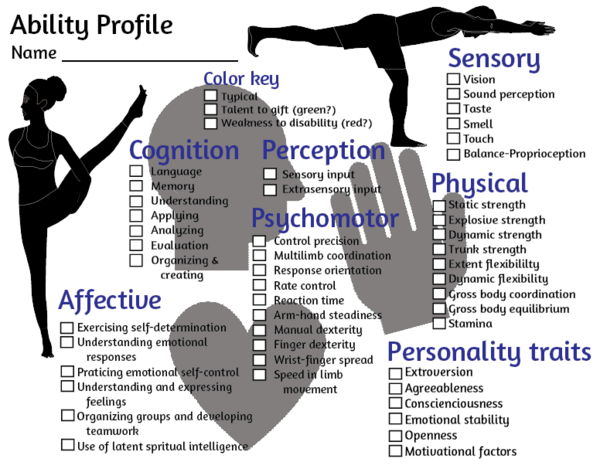
Everyone has innate abilities. Life itself is possible due to a plethora of these. In the Allen, Tingey, Farnes, Millington (ATFM) model, we have identified over two hundred of these (see associated paper). Major categories of this can be seen to the right.
It stands to reason that nurturing, educating, and training should be conducted with these in mind. For one thing, people are likely to enjoy engaging in activities that leverage their abilities. They are likely to be more productive in these ways. Matching them up with associated social groupings and educational institutions is likely to bring more success than the alternative.
Efforts to make such evaluations are traditionally carried out, but such efforts are typically narrow and rigid. In the educational sphere, most programs focus on a narrow range of cognitive and analytical skills, with great rewards for the winners, but the rest are dragged through tainted, if not failed efforts with little left to buoy them up and give them informed direction. This is particularly problematic in the case of people with obvious limitations in some aspect of their lives. In the face of the obvious, insufficient efforts are conducted to identify areas of strength, particularly when such abilities need be sussed out by people capable of recognizing them.
The third tier of the 2020/CIMH/OPL program is to establish pervasive, effective comprehensive ‘abilities Olympics’ for children, youth, and adults at key turning points of their development. Carried out in an environment characterized by fluidity, health, and high performance generally, such efforts are likely to jumpstart preparation programs, and indeed, careers, of people who might otherise be stuck in endeavors that are not well-matched to their capbilities, talents, and gifts.